Coherence
“…an airbag saved my life.”
Those were the words I got to hear when someone knocked on my room’s door. It was my sister. She was laughing.
—Have you seen this? —whilst holding a school notebook.
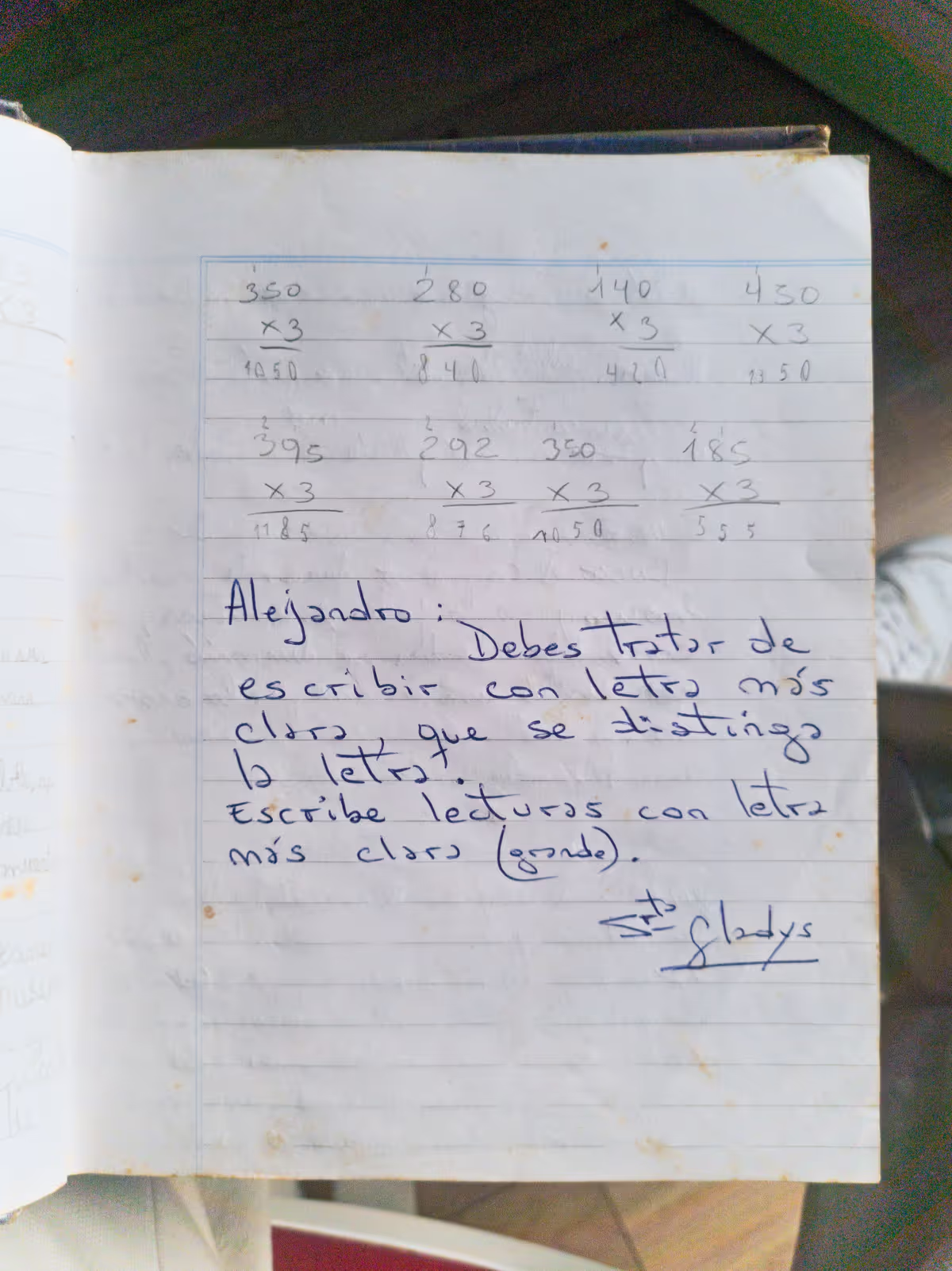
Alejandro:
You should try to use clearer handwriting, so that letters are legible. Write your notes in a clearer (larger) handwriting.
I was 7 years old when this note landed to be noticed by my parents. For reference, this was my handwriting back then. Fun fact: it is a pastry cream recipe. Little did I know I’d find myself writing more recipes decades later!
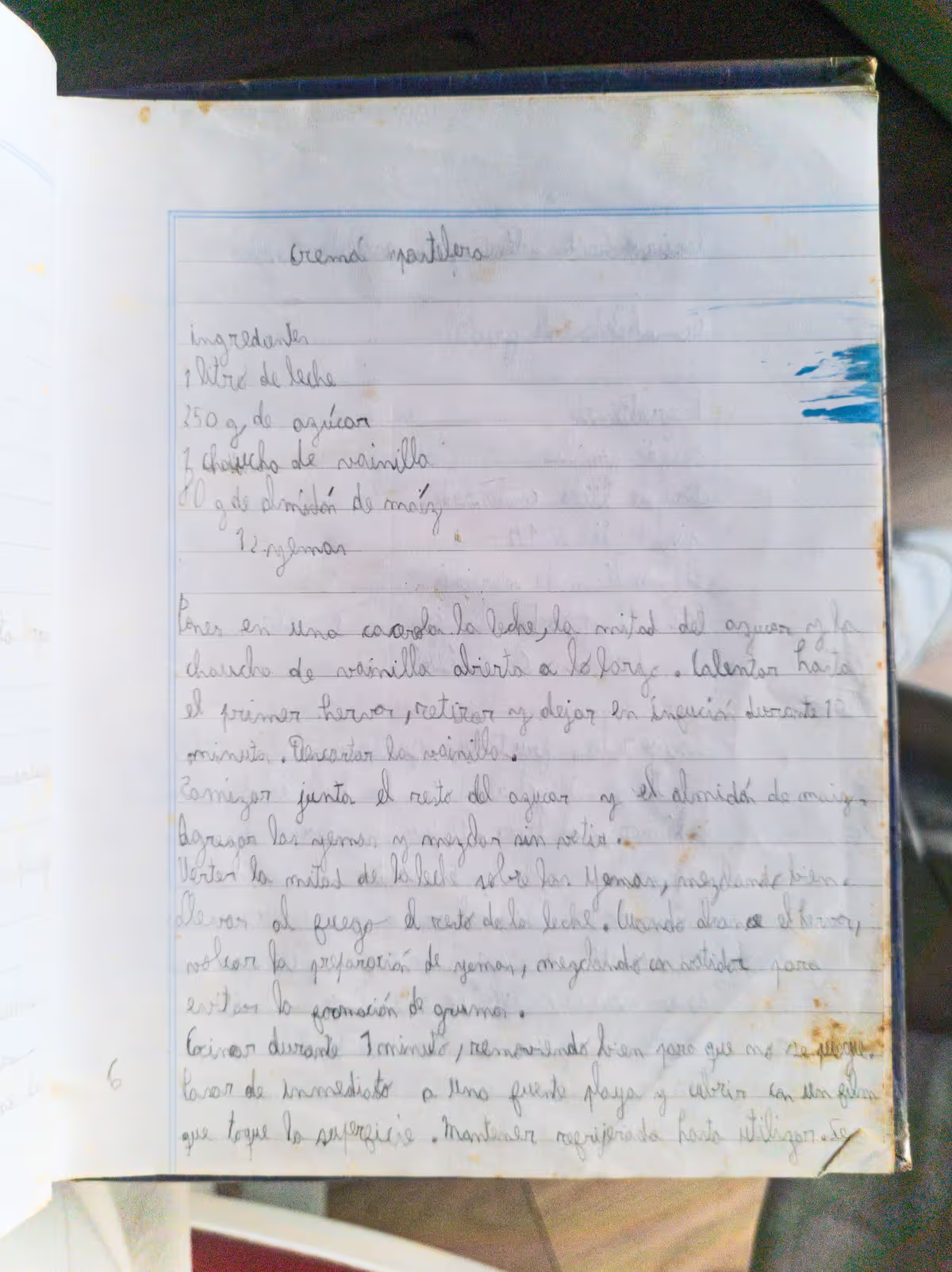
I couldn’t stop laughing when I saw the teacher’s note. I was mostly stunned, to be honest, to know the whole notebook had survived for so long. Such an important piece of history!
Took some photos. Shared some Instagram stories about it. And then, a journey down the memory lane. I would recall bright images from my foundational years, cultivating self-awareness, pondering funny questions. You know, about the origin of consciousness, life, death, the possibility of extra-terrestrial life, how to beat Mega Man 2 Willy Stage 4 boss, and of course, Age of Empires 2 Barbarossa’s campaing. It was damn hard.
I would recall that, at kindergarten, our teachers would introduce us to the different types of letters, mostly in print format. Print is the style you’re looking at, right now.
One year later, at first grade, 6 years old, we would start learning how to write. They would teach us to write in cursive, the one where each letter is connected and has a curvy style to it.
I didn’t like it. There was some tackiness to it that put me off. Maybe due to how bad I was at it. But I do recall inner voices where I would tell myself how confusing it was to write in such type of letter that I never saw anywhere else before. It seemed like the only place it was used was there, at school. Like, as if the purpose of its existance was to fullfill that role.
After some puzzling connections I managed to glue inside my head, trying to make sense of it all, my final hypothesis was born:
“Well, this must be it: I’m at school, we all use it there. Hence, I should follow through.”
A year or two passed. To no avail, I still thought cursive was ugly. My cursive, everyone else’s cursive. Some were slightly better, but never breaking through the ugly threshold.
That teacher’s note about my illegible handwriting was written when I was 7 or 8 years old. I often got these remarks from my teachers and everyone else around. It wasn’t an isolated case.
I remember never, ever being satisfied with my cursive style. Of course Gladys was right. And so was anyone trying to read my notes without a pharmacist’s training.
I invested weeks.. no, months of effort practicing writing. Most of the time forced to do so. I eventually improved, but never to the point where I was happy with it.
Aside from it, I spent hours upon hours doing all sorts of things on the computer. Always mesmerized by graphical work, be it in the form of video games or just the UI/UX of the operating system. Windows 98 at the time. At some point, I thought:
“How is it possible that the very style they tell us to write in [cursive] is nowhere to be found in any piece of media out there? Not TV. Not computers. Not video games. Not posters, nor billboards across the streets. Why’s that?”
I kept wondering:
“I really dig the aesthetics of it [print]. Why aren’t we learning that one? Not that my classmates are doing much better with cursive either. It would make things much easier. I would feel more connected to my surroundings. It would feel meaningful. I mean, that seems to be the type of lettering everybody else doing real, serious, adult work is using, right?”
It felt like I stumbled into a definitive cure for my uninspiring lettering.
“This is it. My moment to shine has come.”
One day I was through one of these dreadful writing exercises. Years of cumulative frustration about the whole issue led me to reach assertiveness in myself:
“Tomorrow will be the day. There is no going back.”
And tomorrow came. Sitting in my desk, staring down my own cursive in my school notebook one last time, I inhaled profoundly. “I’ll be free. No longer would I question my own expressive sanity. The beginning of a new era is right there.”
Only then, I found the courage to stand up and reach for my teacher:
—Miss, can I write in print style?
—No. Only cursive is allowed.
As if the nature of my question were as ephemeral as her answer.
…
I’ve lost. I felt devastated.
I had no choice.
I was on my knees to cursive.
Cursive was here to stay.
Never asked about it again. Too much shame for such stupid request. How could I have brought up something so silly?
Comments about my unreadable handwriting kept coming, from all sides. Sometimes in odd forms: “Interesting that you, as a boy, write in such small letters. That’s more of a girl thing, boys tend to write bigger.”
I never knew what to do with those. Not pleased, not insulted. I took them as observations, which I think was the healthiest thing I could’ve done. In retrospect, I wonder if they were softened criticism dressed up to not sound harsh. I don’t know. But I’d gotten used to them.
Fast forward to high school. At 16, teachers started drilling us in technical lettering defined by the IRAM 4503-1 standard. My high school was heavily technical and leaned towards engineering. We would make technical drawings of things a mechanical engineer would obsess over. Screws, pulleys, threads, motor parts, the list goes on.
They would teach us to write the labels on these drawings following that standard, as it was the norm. We would have calligraphy lessons to master it by hand.
The goal was to normalize handwriting into something cohesive, readable by anyone without effort. Same idea our primary school teachers had with cursive… hmmmm, I’ve heard about that one before. But hey, this is print. Might be worth the try, I suppose.
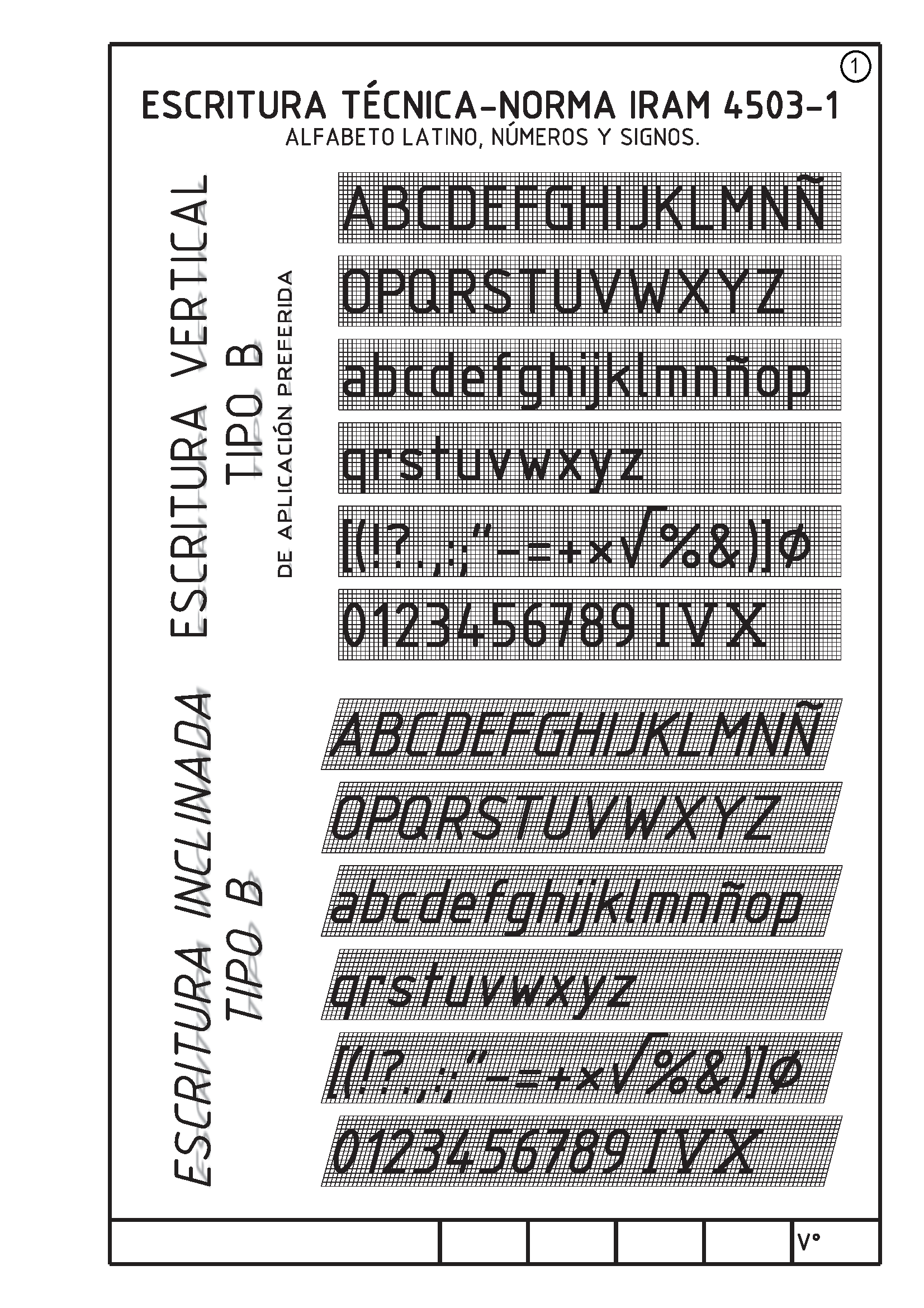
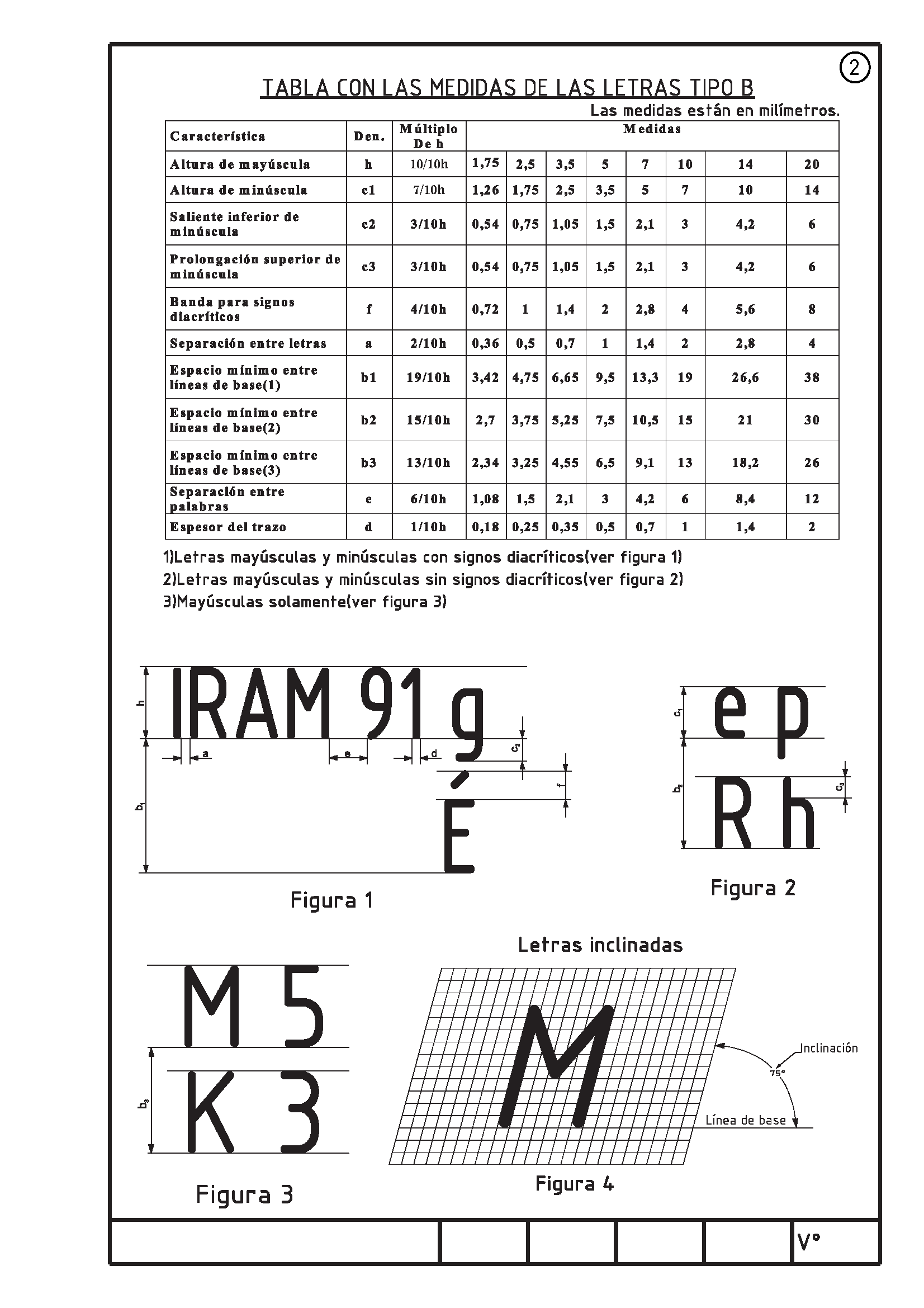
The IRAM 4503-1 norm (rooted in ISO 3098-1) laid out a constructed alphabet: letter shapes, proportions, stroke thickness, spacing. Not a typeface in the modern sense, more like an algorithm for drawing letters. The PDF we were handed also included practice sheets we would use in our calligraphy lessons.
Related: DIN 1451. This is an actual designed typeface, born in Germany for signage and industrial labeling. Different lineage, but same neighborhood: sans-serif, geometric, monoline, built for legibility. There’s many variants, revisions, forks of DIN. It’s such a beautiful typeface. I didn’t have many opportunities to put it to work, but I guess it’s a matter of time.
Back to the point, here’s the PDF of the IRAM standard we used. Look at this marvel:
By that time, anyone actually working in engineering would just do these drawings on the computer, and, by extension, the lettering too. Print it out, or send the PDF in some bureaucratic, dreary mail exchange between peers. But no, we had to learn it by hand. Tradition, I guess.
Though, in fairness, maybe the by-hand part was doing something I didn’t see at the time. We’re only starting to notice as a society, now that handwriting is fading, that something changes when the hand stops moving.
The thing is, it finally, FINALLY broke the chains of cursive for me. Turns out writing in print had always been allowed at high school. I’d just been psyop’d into the forever-cursive idea and never noticed.
Today, my handwriting style is print.
The calligraphy classes did help a lot in improving its clarity. People no longer question my lettering anymore.
Even though I mostly use digital mediums when I need to write something, I still keep a notebook around. Some ideas seems to surface in a rather different way due to this pen-and-paper, thoughts-and-hand analog connection.
Somewhat related, my favourite typeface: the Inter family.
Alright! Let’s pack it up.
What a cool memoir about my cursive deconstruction.
One last time, I find myself pondering my teacher’s note, nostalgic…
Am I getting older? Time flies, indeed…
…wait.
Hold on a second. Is that…
…did Miss Gladys actually… oh Lord.
SHE WROTE IT ON FREAKING PRINT.
~ breathe in ~~ breathe out ~
I didn’t see it back then.
Nor did my parents. Nor did anyone.
I’m not even sure my teacher noticed.
Can’t believe it.
I’ve been gaslighted into cursive. For years.
(I can’t stop laughing as I write this)
Told mom about this realization. She was shocked the same way I was. Quick after then she manages to bring up another mesmerizing piece of history:
—Back then, you would also do math exercises in your head. From start to end. You were pretty quick with numbers and found writing the “auxiliary operations” (basically the step-by-step calculations on paper) a waste of time. So you would do them in your head, come up with the correct result almost every time, and score perfectly on tests. But teachers were upset about it, and they would take off (!!) points from your tests because you didn’t write the auxiliary operations. Because they had “no way” to verify how you got the result. Which is absurd, since it’s not like you were carrying a calculator or anything. But those were the rules. To me, the fact that you didn’t need all that would warrant even more appreciation, if that makes sense.
That one landed hard.
A punishment for being too efficient. I remember being pissed off as a kid about it. Like the cursive thing, but this one was worse. The resentment was so big that I would rebel against the idea and not comply with these “requirements.”
“Alejandro, please, do the auxiliary exercises when doing homework, and also for tomorrow’s test”. Hell no. Cursive was enough nonsense. I genuinely thought the rule was one of the most stupid things I’ve ever came across in my then short lived experience.
I stuck to my principles and would skip the auxiliary exercises as much as possible. I could not conceive the idea that being faster and not needing to write down stuff, that to say “I can just do it in my head – look!” was not a cause for celebration. Quite the opposite. That I would be put down for the hysterical “verify” reasons above.
At that moment I’ve started to wonder if adults were always right, as they used to preach. It evolved into skepticism toward authority and the powers that be. Me, 6 years old. A decade or so later, it all made sense when I realized the system had been working exactly as intended all along.
Luckily, my parents understood how nonsensical this was. They got involved in discussions with my teachers about it. I think this happened in pretty much all grades at primary school. Thankfully, they all came around, in peaceful and diplomatic terms. Some of my teachers would later apologize to me personally, and allow me (and others) to skip auxiliary operations if we felt we didn’t need them.
Love to Miss Gladys, though. Honestly, she’s one of the best teachers I’ve ever had. Her lettering was pretty good too, now that I can appreciate it without the extra anxiety it induced back then, when I had to show the note to my superiors.